
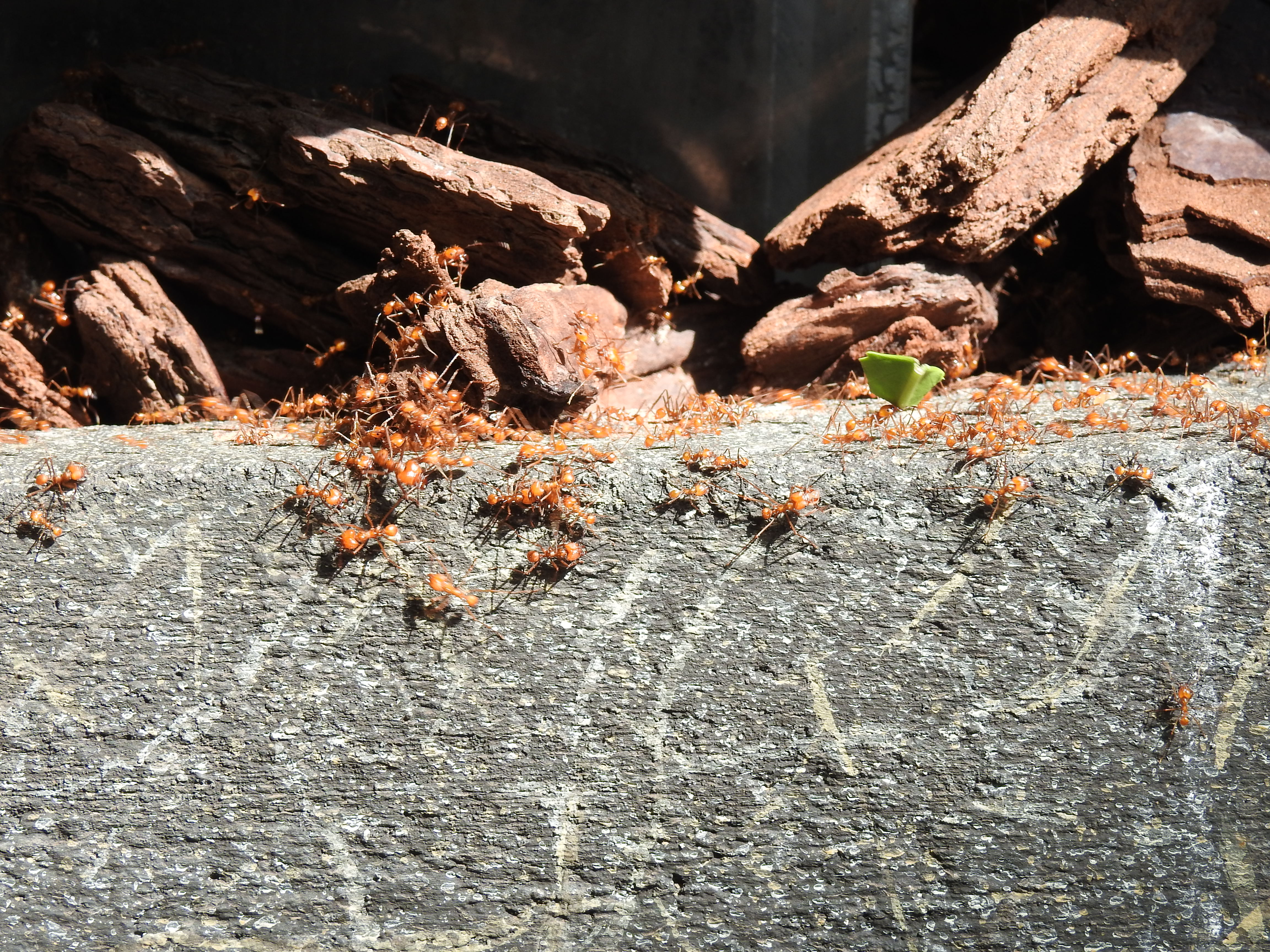
MAKING MY PEACE … with not carrying the load alone – like ants !
On some days, life can feel heavy. Challenges pile up, and we may wonder if we’re carrying too much alone. But nature, as it so often does, has lesson for us. In this case, the lesson is from a small but mighty teacher: the weaver ant.
A recent study published in New Scientist in August 2025 looked at how weaver ants build their leafy homes. When a single ant pulls on a leaf, it can manage an astonishing 60 times its own body weight. That’s impressive.
Weaver ants, found in northern Australia to south Asia, form long chains to pull on leaves to roll them up and build their nests. They can outpull just about any other creature, kilogram per kilogram, pound for pound, in the entire animal kingdom.
When weaver ants form a team, the strength of each ant nearly doubles. The researchers at Macquarie University in Sydney, Australia, found that a team of 15 ants could pull over 100 times their body weight. Instead of getting tired or holding back (as often happens in human teams), the power of weaver ants grows the more they work together. That’s even more impressive.
How do they do this?
The ants do this by creating chains. Each ant links its mandibles (jaws) onto the abdomen of the ant ahead, and some brace themselves against the ground, turning individual effort into collective force. The brilliance is in their ability to link together to become more effective as a team than as strong individuals. Strong alone, but strongest together.
The lessons here are:
Teamwork heals the weight of isolation: Just as ants lock onto one another for stability, humans need support too, sometimes physically and sometimes with kind words or shared moments together.
Together, we amplify one another’s strengths: In times of grief, stress, or uncertainty, a person’s encouragement or small gesture can multiply the resilience of a group or team. Even the smallest of creatures knows the secret that we’re strongest when we pull together. Remind yourself: you don’t have to carry it all alone.
A “team” can be a circle of friends, a support group, an online community, or even a family member, a colleague, a neighbour, or a loved one. Each link matters. Each connection anchors and strengthens the chain.
***
Making my peace with not carrying the load alone – like ants – I try the following:
Name my anchor people: I write down the names of three people who might help me with a specific task or situation – currently or in the future.
Express gratitude: I reach out to people with a short message of gratitude. A simple “thinking of you” or “thank you for being there” can reinforce the chain, the link, between us.
Be the link for someone else: I try to do a small supportive action for someone in my circle of friends and family from time to time. This could be to be present, to listen to them, share a resource, help out, or check in.
***
Rainy Day Healing blogs: “This kind of quiet, honest reflection is exactly what makes Rainy Day Healing such a special space.” Chaz. T., USA


In a world of sensory overload, Tranquility Mapping offers a gentle, creative way to reconnect with peace and calm, and recreate restorative spaces. Whether you’re seeking stillness in a busy home, serenity in a classroom, or relief in a hectic office, this guide gives you the tools to map and reshape your environment to support your well-being. Whether you have a garden, one room or an entire building to work with, this guide helps you transform your everyday spaces into sanctuaries of stillness.
Includes: Tranquility Mapping templates and examples (for home, classroom, school, and office); A Tranquility Toolkit checklist (sound, scent, sight, and texture tools); A teacher’s guide to mapping calm with students; A list of workshop questions and techniques for working with groups; Real-life inspiration based on research on peace and tranquility.
Ideal for: Anyone seeking a sensory-friendly space and a place of quietude; Teachers and educators designing calm corners for students in classrooms and learning spaces; Families, parents, and caregivers wanting to create calm for children, seniors, and all members; Therapists, coaches, and wellness professionals; Human resource personnel, office planners, and office workers reclaiming restorative spaces.
Map your way back to tranquility. Map emotional geography in real life. Feel the benefits of restorative spaces. If you have a notebook, blank paper, pencils, crayons or highlighters, and optional stickers and sticky notes, you can begin. You don’t have to wait for peace to find you. You can find it, design it, and return to it anytime. You can design the tranquility you want to feel.

Leave a Reply