
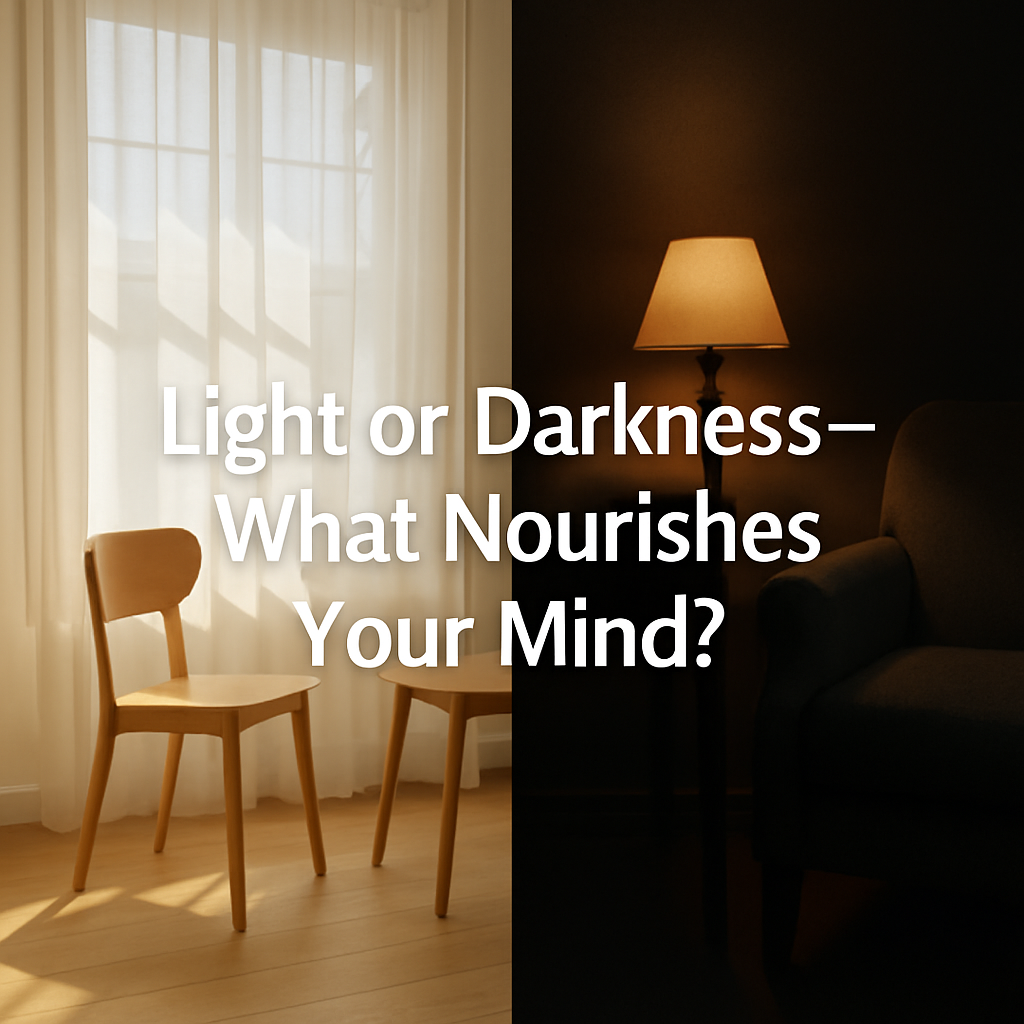
MAKING MY PEACE … with the lights off
… Lights on or lights off? … How lightness and darkness shape our moods and mental health …
Balancing the amount and intensity of lightness and darkness in your life is deeply personal. Everyone has a preference. My mother, for example, loved to sit in near darkness, a habit shaped by an earlier generation’s sense of thrift to save energy and money, and through living in wartime Berlin. When I visit her, I respect her dark surroundings even though I can’t read anything! I, on the other hand, crave light, especially natural daylight streaming through the windows. For me, a sun-filled room feels alive, while shadows seem to drain my energy.
Not everyone feels this way. Some friends close their curtains during the day, creating a cocoon of darkness that feels safe and calming to them. One of my friends sleeps only in total darkness, using an eye mask to block out every stray beam of light. I, on the other hand, detest closed curtains, choosing not to have any, and to wake naturally with the break of dawn.
These days, our choices are layered, not only with personal preferences, but also with the question of energy conservation. Is there a balance for our mental health in terms of lightness or darkness?
Light matters. Light is more than aesthetics; it is biology. Exposure to natural light influences our circadian rhythms, regulates our body’s melatonin production, and affects serotonin levels — all of which play key roles in affecting our mood.
Lightness can help to boost mood. Bright light, especially sunlight, can lift our spirits and is even used in light therapy for seasonal affective disorder (SAD). Light improves focus, and well-lit spaces tend to enhance productivity and alertness. Light also supports sleep-wake cycles. Morning light exposure helps reset the body clock, making it easier to wake up refreshed.
Darkness, though, has its own special healing properties. When everything is dim or dark, the nervous system tends to relax. Darkness signals safety for some people and helps us wind down from mental, social, or physical activity.
Darkness encourages rest. Darkness is essential for deep sleep, and even small light sources can disrupt melatonin production. Darkness can soothe anxiety for some people as low-light and night environments can feel calming, reducing sensory overload. Darkness also promotes Introspection. In the quiet of darkness, many people find space for reflection or meditation.
Too much light and too much dark have their disadvantages. Harsh artificial lighting late at night can overstimulate the brain and disrupt sleep. Staying in dim spaces during the day, or for extended periods, can lead to lethargy and low mood, even increasing the risk of depression for some.
While our discussion has focused on mood and mental health, it’s worth noting that natural light also plays an important role in physical well-being, especially bone health. Exposure to sunlight triggers the production of vitamin D in the skin, which is essential for calcium absorption. Calcium and vitamin D work together to maintain strong bones and reduce the risk of osteoporosis as we age.
Even short periods outdoors, such as 10 to 30 minutes of sunlight a few times a week, can help keep vitamin D levels in a healthy range, depending on skin tone and location. For those who spend most of their time indoors, adding short breaks in natural light or near windows can support both mood and bone density. However, artificial lighting typically does not produce the UVB rays needed for vitamin D, unless it’s a specialized UVB lamp.
***
Making my peace with lights off, I try to balance the circadian rhythms (the physical, mental, and behavioural changes a person experiences over a 24-hour cycle), by:
In the morning: I keep curtains open to let in the dawn light. Waking up with natural brightness helps me start the day calm and yet energized.
In the daytime: I work near windows, in bright natural light. On cloudy days, I use warm LED lamps to keep things cosy but bright.
In the evening: I shift to softer, golden lighting and avoid harsh overhead lighting. This helps signal to my brain that night is coming.
At night: I sleep with curtains open but regulate this preference with turning off non-natural light sources, such as TV glow, phone light emissions, and other electrical lights.
This rhythm gives me the energy of lightness and the calm of darkness that suits me, without feeling overwhelmed by either.
***
Rainy Day Healing blogs: “This kind of quiet, honest reflection is exactly what makes Rainy Day Healing such a special space.” Chaz. T., USA


In a world of sensory overload, Tranquility Mapping offers a gentle, creative way to reconnect with peace and calm, and recreate restorative spaces. Whether you’re seeking stillness in a busy home, serenity in a classroom, or relief in a hectic office, this guide gives you the tools to map and reshape your environment to support your well-being. Whether you have a garden, one room or an entire building to work with, this guide helps you transform your everyday spaces into sanctuaries of stillness.
Includes: Tranquility Mapping templates and examples (for home, classroom, school, and office); A Tranquility Toolkit checklist (sound, scent, sight, and texture tools); A teacher’s guide to mapping calm with students; A list of workshop questions and techniques for working with groups; Real-life inspiration based on research on peace and tranquility.
Ideal for: Anyone seeking a sensory-friendly space and a place of quietude; Teachers and educators designing calm corners for students in classrooms and learning spaces; Families, parents, and caregivers wanting to create calm for children, seniors, and all members; Therapists, coaches, and wellness professionals; Human resource personnel, office planners, and office workers reclaiming restorative spaces.
Map your way back to tranquility. Map emotional geography in real life. Feel the benefits of restorative spaces. If you have a notebook, blank paper, pencils, crayons or highlighters, and optional stickers and sticky notes, you can begin. You don’t have to wait for peace to find you. You can find it, design it, and return to it anytime. You can design the tranquility you want to feel.

Leave a Reply